You just hung up with a prospect. The call went well. You send a follow-up email, and they don't respond.
What should you do next? Do nothing and hope they come back? Email something, but what? Submit a proposal? If every option feels wrong, you're not bad at sales. You're experiencing something I call follow-up decision fatigue, and it's one of the most common reasons good opportunities stall inside boutique consulting firms.
What is follow-up decision fatigue?
Follow-up decision fatigue is the paralysis consultants feel after a sales conversation when they want to follow up but can't decide how. No next move feels right, so they either wait too long or reach for something that misses the mark.
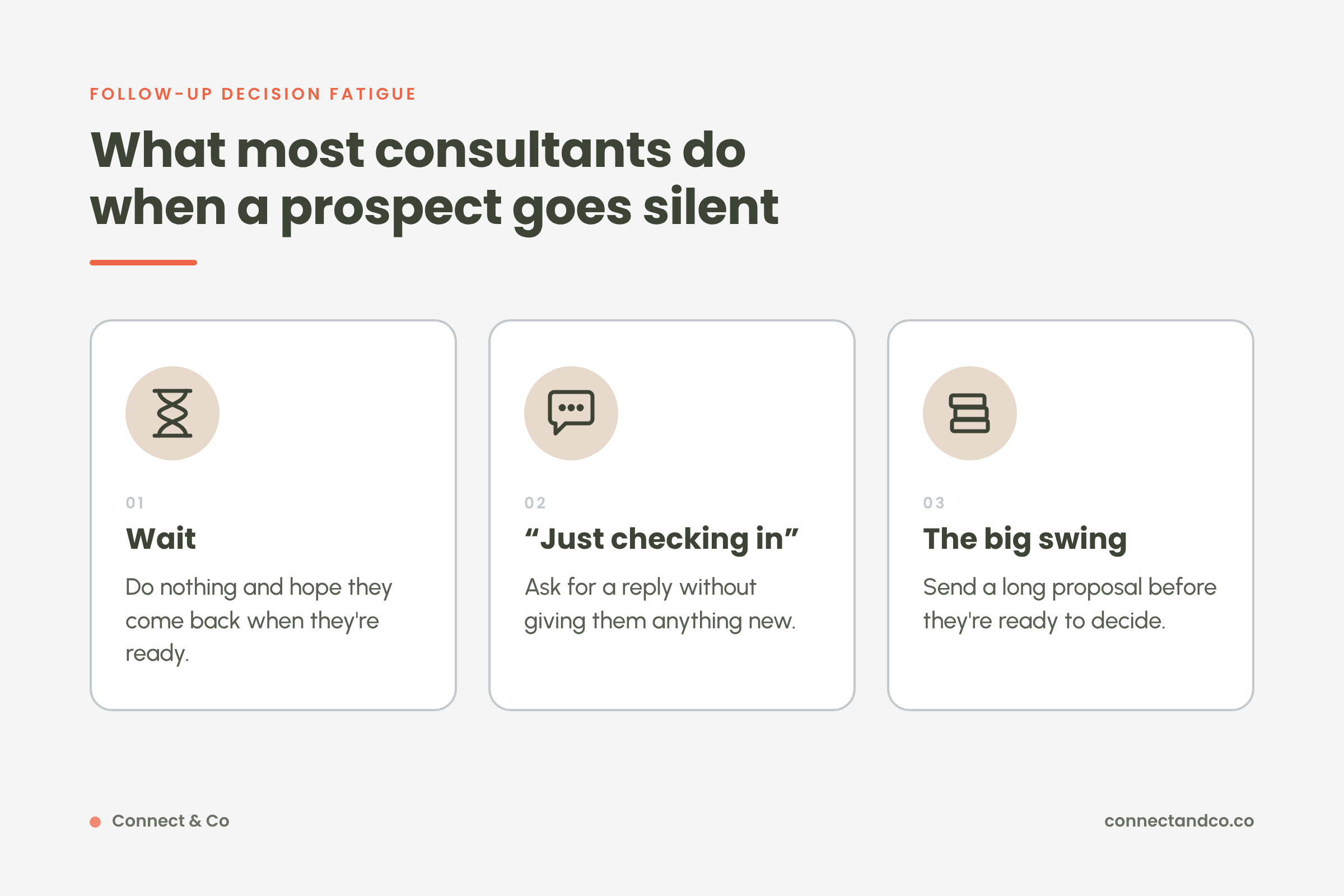
It shows up in three familiar ways:
Waiting. You don't want to seem pushy, so you do nothing and hope the prospect reaches out when they're ready.
"Just checking in." You send a short note that asks for a response but gives the prospect nothing new.
The big swing. You spend hours on a detailed proposal before the prospect is ready to make a decision.
None of these are the result of bad judgment. They're the result of making the same decision from scratch after every single call. When there's no process to lean on, each follow-up becomes a fresh guessing game, and the mental load adds up across every open conversation in your pipeline.
The takeaway: if you feel stuck after a good call, the problem usually isn't the prospect. It's that your next step was never decided ahead of time.
Why consultants struggle after a good sales call
You're an expert in your field. You know you can help this prospect. So why is this moment such a struggle?
A big reason is that you don't know if they're still interested, and you feel like you need to know before taking the next step.
It's quite similar to dating. If someone doesn't text you back after the first date, you assume they don't want another date. But they didn't actually tell you that. So you're left in a state of uncertainty, filling the silence with your own story.
Prospects work the same way. Silence after a sales call rarely means "no." More often it means your prospect is busy, managing their own team and priorities, and your conversation hasn't risen to the top of their list yet.
Here's what consultants often don't realize: selling is a journey into the unknown. You will rarely have full visibility into what a prospect is thinking. Unless you learn to move forward without all the answers, follow-up decision fatigue will keep showing up, and good opportunities will keep slipping away.
The takeaway: stop waiting for certainty about the prospect before you act. That certainty almost never arrives on its own.
Silence isn't a decision: a real example
I recently received a DM on LinkedIn from someone who said a past client of mine had referred them. They specifically asked for a conversation, so I wrote back and offered times for a call.
After four days, I hadn't heard back.
I could have taken that to mean they'd changed their mind. Instead, I didn't let their silence make the decision for me. I found their email address and sent the same message to their inbox, off LinkedIn.
A few hours later, they booked a call in my calendar.
Nothing about my message changed. What changed was that I treated silence as missing information, not as an answer. A referred prospect who asked for a conversation hadn't lost interest. My message simply hadn't reached them where they were paying attention.
The takeaway: before you interpret silence as a no, ask whether your follow-up actually reached the person, and whether you've given them a real reason to respond.
You can't control what they think. You can control your next move.
In business development, you can't immediately remove the uncertainty about what your prospect is thinking. But you can remove the uncertainty about your own next move.
That's what BD infrastructure is for. At Connect & Co, we define BD infrastructure as the repeatable processes, messages, and resources that move a prospect from first conversation to signed client, built into the firm so they don't depend on anyone's mood or memory.
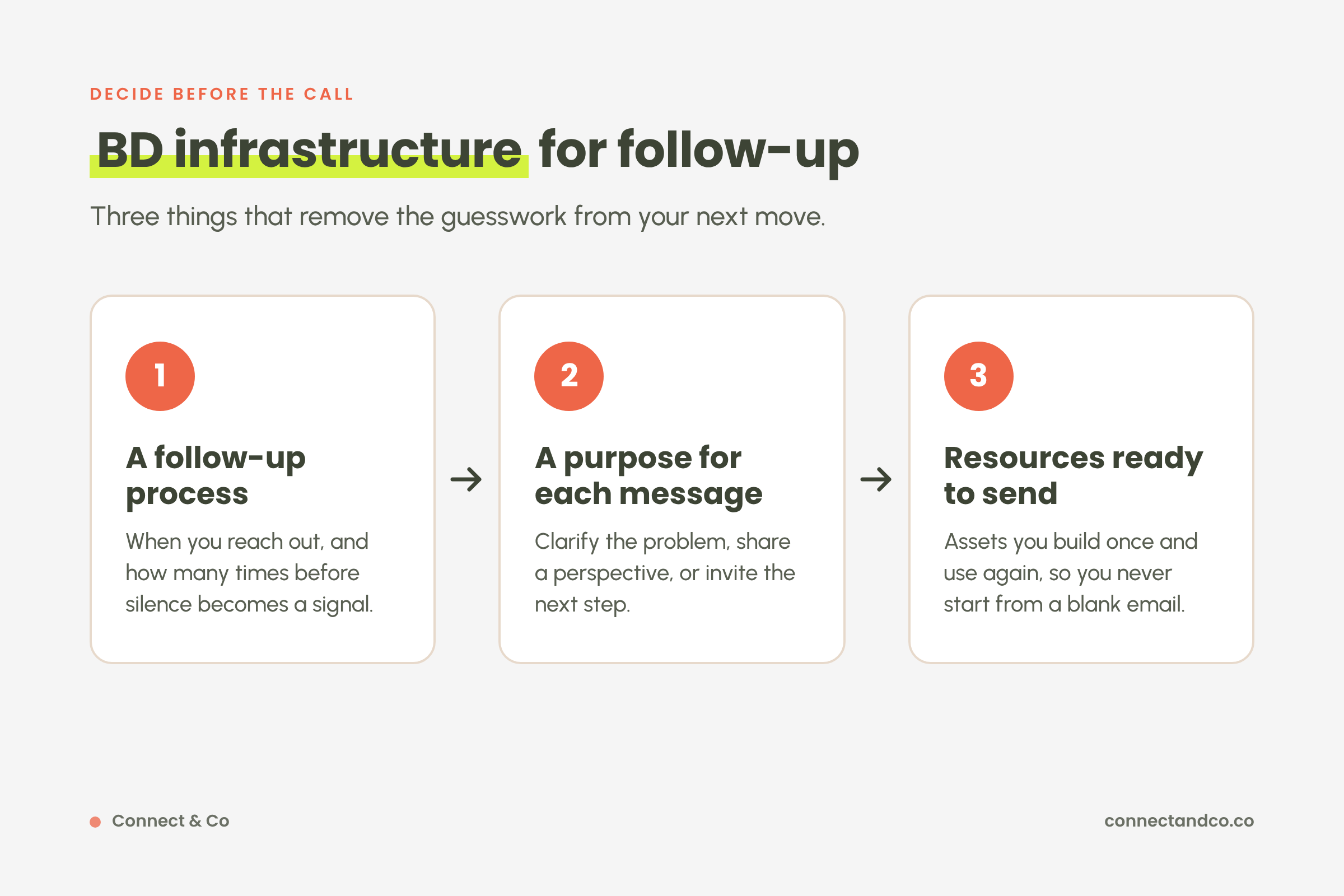
For follow-up specifically, that means three things are decided before the call ever happens:
A follow-up process. When you reach out after a conversation, and how many times before you treat silence as a signal.
A purpose for each message. Every follow-up has a job: clarify the problem, share a perspective, or invite the next step.
Useful resources ready to send. Assets you build once and use again and again, so you never start from a blank email.
When those pieces exist, follow-up stops being a judgment call and becomes a step you take. You can lead your BD process with confidence because the hardest decision was already made.
The takeaway: write down what you send after a first call. If you can't, that's the piece of infrastructure to build first.
Following up isn't pushy. Following up with nothing is.
"But, Celina, won't I seem pushy?"
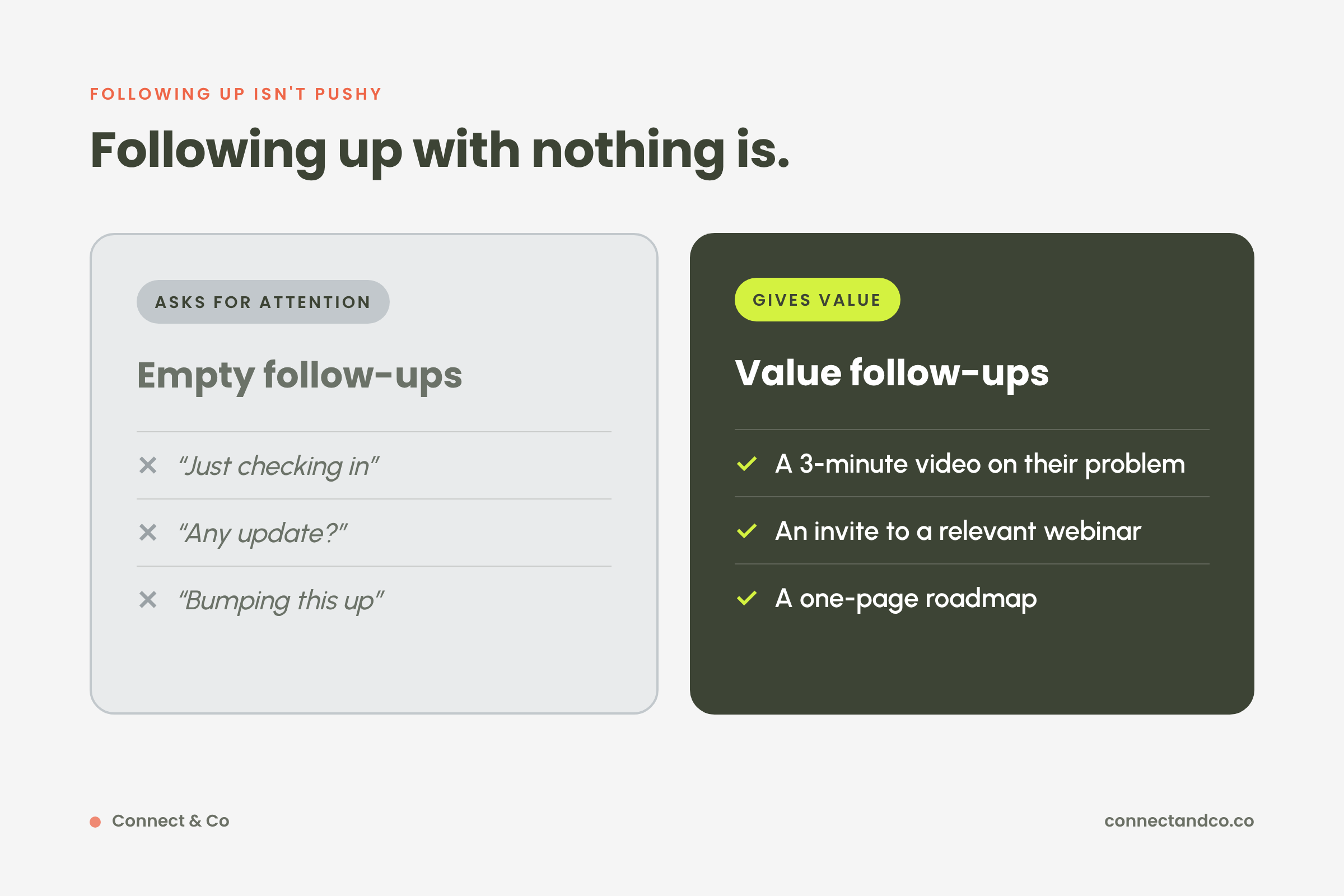
Here's how I see it. If you continue to send emails saying "just checking in," that can feel pushy. Or just annoying. Those emails ask the prospect for something (a reply, their attention, a decision) without offering anything to help them make an educated decision about solving their problem.
Value changes the equation. When your follow-up helps the prospect think more clearly about their problem, it stops reading as a chase and starts reading as expertise. That's value without expectation: you're giving them something useful whether or not they reply right away.
And if they still don't respond? That's information too. It may not be the right time. It doesn't erase the trust you built by showing up with something worth their attention.
The takeaway: before you hit send, ask, "Does this message help them, or does it only help me?"
Follow-ups that give prospects a reason to respond
Two follow-ups consistently move conversations forward without overwhelming a prospect.
1. A three-minute video. Record a short screen-share or talking video explaining why they're experiencing their problem and how to solve it. Say their name so they know it's for them. Keep it to about three minutes, because longer starts to feel like homework. A video like this shows how you think without asking for another hour on their calendar.
2. A webinar invitation. Invite them to a webinar with insights about the solution to their problem. It gives them a low-commitment way to learn more from you and a natural reason to re-engage.
A third option works well when you've already discussed scope: a one-page roadmap that lays out the phases, rough timing, and what an engagement would ask of their team. It helps the prospect picture working with you, without the weight of a 25-page proposal.
What these have in common is that none of them need to be built from scratch for each prospect. The structure stays the same, and the prospect's situation sits on top. That's what makes them infrastructure, not one-off effort.
The takeaway: pick one of these and build a reusable version this month. Your next stalled conversation will thank you.
The real fix for follow-up decision fatigue
The next time a good conversation stalls, ask yourself: "What can I share that would help this person move forward?"
You may not know whether they're still interested. But when your follow-up has clear value and intention, you can feel confident sending it.
Follow-up decision fatigue isn't a confidence problem or a prospect problem. It's an infrastructure problem. When the highest-leverage moment in your sales process gets improvised every time, the deal is left to chance. When your next step is decided before the call ever happens, you stop managing your own uncertainty and start managing the deal. That's what it means to build revenue on purpose.
Ready to stop guessing after every call?
Have you stalled out on a number of prospects because you're unsure what to do next? Schedule a BD Strategy Session. We'll talk about where you're getting stuck and figure out your next moves together.
Frequently Asked Questions
What should I do when a prospect stops responding after a good sales call?
Follow up again, but with something useful rather than a "just checking in" note. A short video explaining their problem, a webinar invitation, or a one-page roadmap gives the prospect a reason to re-engage. Also check whether your message reached them where they actually pay attention; sometimes switching from LinkedIn to email is all it takes. One unanswered message is not enough information to stop.
How many times should a consultant follow up before giving up on a prospect?
More than once. A single unanswered follow-up usually means the prospect is busy, not uninterested. Celina Guerrero, founder of Connect & Co, recommends deciding your follow-up cadence ahead of time as part of your BD process, so you're not making that call emotionally after each conversation. If several value-driven follow-ups go unanswered, treat that as a signal that the timing isn't right for now.
What is follow-up decision fatigue?
Follow-up decision fatigue is the paralysis consultants feel after a sales conversation when they want to follow up but can't decide how. It happens because they're making the same decision from scratch after every call, usually while uncertain whether the prospect is still interested. The result is waiting too long, sending empty check-ins, or overbuilding a proposal. The fix is BD infrastructure that decides the next step in advance.
What does BD infrastructure have to do with following up on prospects?
BD infrastructure is the set of repeatable processes, messages, and resources that move a prospect from first conversation to signed client. For follow-up, it means you already know when to reach out, what each message is for, and which resources to send. Connect & Co builds this infrastructure inside boutique consulting firms so follow-up no longer depends on guesswork or mood. It turns the moment after a sales call into a step you take, not a decision you agonize over.
How do I follow up with a prospect without seeming pushy?
Lead with value. Prospects perceive follow-up as pushy when it asks for their attention without giving them anything in return, like a string of "just checking in" emails. A follow-up that helps them understand their problem or see a path forward reads as expertise, not pressure. Ask yourself whether the message helps the prospect or only helps you before you send it.
Should I send a proposal if a prospect isn't responding?
Usually not. A detailed proposal asks a busy prospect to make a decision they may not be ready for, and it can bury the insight that made the first call valuable. A short, specific follow-up, like a three-minute video or a one-page roadmap, builds trust with far less effort on their side. Save the full proposal for when the prospect has confirmed the problem, priority, and next step with you.